
Decide whether to add resin first or treat the surface of the finished product
PU leather can put forward antibacterial requirements in different aspects such as material preparation and surface finishing. First clarify the PU resin, solvent or water-based system used, coating location and actual contact surface, and then decide on the process; resin addition and finished product spraying do not use the same set of conditions.
Oily PU resin can be viewed as AEM5700-C
AEM5700-C is used for anti-mould and antibacterial addition to oily liquids and PU and PVC resins. We design premixing and feeding according to the resin, solvent and coating process, and develop supporting dispersion, colour and film formation.
Mix a small amount first, then add the entire batch of formula
Premix raw materials with small amounts of compatible materials before adding to the entire batch and recording metering, sequencing and mixing. We make treatment samples and control samples according to the coating, drying and film-forming processes to analyze the leather function and coating quality.
Coating quality and antibacterial function development
- Material body: observe compatibility, dispersion and viscosity changes.
- Film formation: Check surface uniformity, adhesion status and subsequent processing.
- Appearance and feel: Compare colour, gloss, touch and surface after bending.
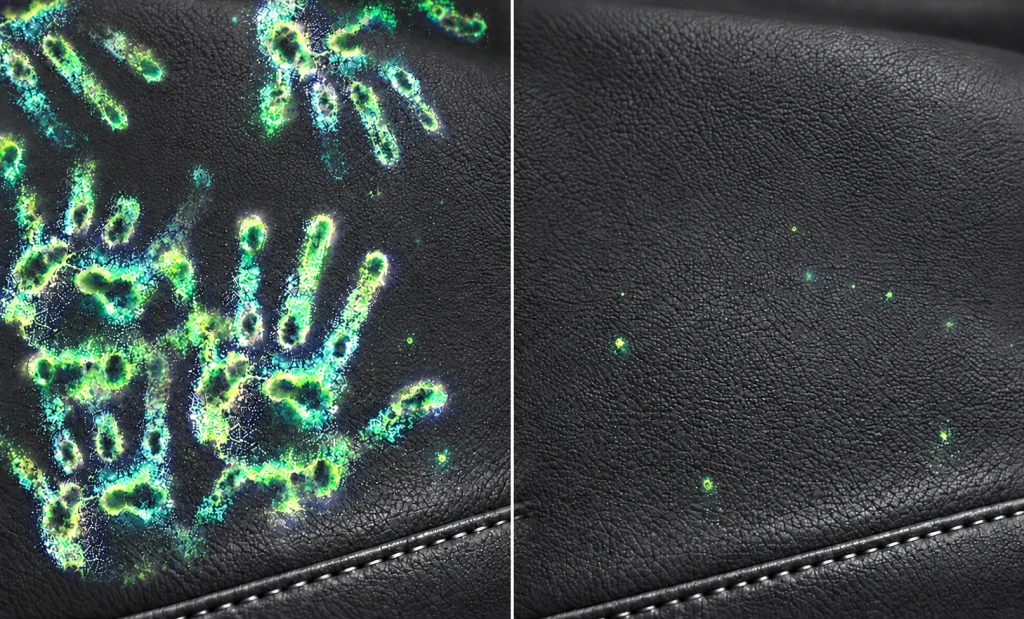
- Usage surface: Use the leather that has been coated and finished to carry out antibacterial evaluation, and support sample testing in cleaning and friction scenarios.
Anti-mould and antibacterial requirements are implemented separately
We design separate evaluation items for mould prevention, antibacterial and odour. Leather that has become mildewed is classified according to material status, and cleaning, damage treatment and repacking are connected.
Corresponding product and model details
Frequently asked questions
How to choose antibacterial raw materials for oil-based and water-based PU?
AEM5700-C corresponds to oily systems. The water-based PU project is developed by engineers matching raw materials according to water-based formulas, supporting compatibility, dispersion and film formation.
If you first look at the transparency of the resin liquid, can you conclude that it has no effect on the leather?
After we complete the coating, drying and finishing, we compare the colour, gloss, feel and performance required for use, and analyze the antibacterial addition and leather quality.
Why do we need to premix a small amount first?
Use a small amount of compatible materials to check mixing and dispersion before adding the entire batch to facilitate early detection of insolubility or colour changes and record the specific order of addition.
Can antibacterial addition remove existing mould spots at the same time?
Production addition and inventory mould cleaning are different processes. If there is any mould, isolate it first and determine whether it is suitable for cleaning, residual colour or damage, and then arrange for subsequent protection and packaging.